What Is a Query String in Google Analytics 4? (2026 Guide)
 Carlos GarciaPublished Updated
 If you have ever copied a link from an email campaign or a paid ad and noticed all the extra text after a question mark, you have already seen a query string in action. In Google Analytics 4, those query strings are not just URL noise. They are one of the primary ways GA4 figures out where your visitors came from, what campaign they clicked, and how to group sessions in your reports. Yet most marketers using GA4 still treat query strings like a black box, which leads to messy page reports, inflated URL counts, and lost attribution data.
What Is a Query String in Google Analytics 4?
A query string is the section of a URL that comes after the question mark and contains one or more key-value pairs separated by ampersands. In Google Analytics 4, query strings are captured automatically as part of every page_view event and stored alongside the page path, where they can either enrich your reports or pollute them depending on how you configure your property.
The classic example is a URL like https://example.com/products?utm_source=google&utm_medium=cpc&utm_campaign=spring_sale. Everything from the ? onward is the query string. GA4 reads each key=value pair, recognizes the UTM keys as campaign parameters, and assigns the session to the matching traffic source, medium, and campaign in your acquisition reports.
Query strings are also how GA4 picks up things like click IDs from Google Ads (gclid), Facebook Ads (fbclid), and Microsoft Ads (msclkid), as well as any custom parameters you decide to track yourself, such as internal site search terms or product filter selections.
Not sure whether your query strings are flowing into GA4 correctly? Get a free GA4 audit from SEO Stuff and we will check your event data, attribution, and URL hygiene in one go.
Free audit
Where do you stand in AI search?
A manual SEO + AI search audit of your site: how ChatGPT, Gemini, Perplexity and Claude read and cite it today, and what to fix first. Report within 48 hours, no credit card.
Get my free auditOr have it all done: AI SEO services, $999 once
How Query Strings Work in a URL
Before you can debug or optimize query strings in GA4, it helps to understand how they are structured in any URL, regardless of analytics tooling.
The Anatomy of a URL With a Query String
A URL with a query string has four key parts. The protocol (https), the domain (example.com), the path (/products), and the query string itself (?utm_source=google&utm_medium=cpc). The question mark signals the start of the query string. Each parameter is a key=value pair. Multiple parameters are joined with the & symbol.
Common Query String Keys You Will See in GA4
The five UTM parameters (utm_source, utm_medium, utm_campaign, utm_term, utm_content) are the most familiar, but GA4 also recognizes platform click IDs by default and lets you create your own. Custom keys are unlimited as long as you stay within URL length limits, and GA4 will surface them as event parameters if you configure them as custom dimensions.
Why GA4 Cares About Query Strings
Three reasons. First, GA4 uses query strings to attribute traffic sources when a referrer is missing or unreliable, which is increasingly common as browsers strip referrer headers. Second, query strings let you pass first-party data into GA4 without relying on cookies. Third, they enable per-link tracking inside a single campaign, so you can distinguish a Facebook newsfeed click from a Facebook story click even though both come from the same domain.
How GA4 Captures Query Strings
Out of the box, GA4 captures the full URL of every page view, including the query string. The behavior is automatic for the page_view event collected by the Google tag, but how that data appears in reports depends on a few settings.
Default Behavior
When a user lands on https://example.com/products?utm_source=google, GA4 records a page_view event with the page_location event parameter set to the full URL. UTM parameters are then parsed out and assigned to the session-level traffic source dimensions. Click IDs like gclid are matched against your linked Google Ads account to enrich attribution.
What You See in Reports
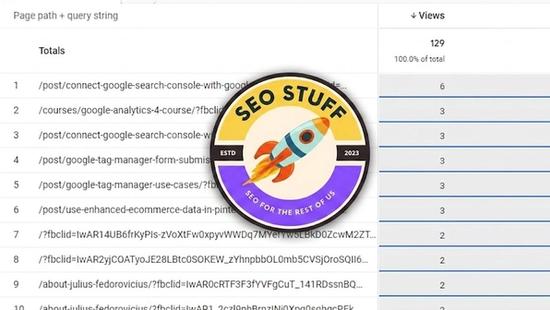
In the Pages and Screens report, GA4 groups page views by page_path, which by default excludes the query string. You will see /products rather than /products?utm_source=google. This is intentional, because grouping by path keeps reports readable and rolls up traffic from many different campaigns onto the same content row.
Want to see how your top landing pages are being affected by query strings and attribution gaps? SEO Stuff's free audit maps your highest-traffic URLs against your GA4 source/medium data to find leaks.
When Query Strings Show Up Anyway
There are several situations where query strings appear in your reports as part of the path. The most common one is when you use the Pages and Screens report and switch the primary dimension to page_location instead of page_path. You will also see query strings in event-level explorations and in BigQuery exports, where the full URL is always preserved.
How to Control Query Strings in GA4
You have three main tools for managing query strings in GA4, and most properties need a mix of all three.
Mark Query Parameters as Cross-Domain Excluded
In the Admin section of GA4, under Data Streams, you can mark specific parameters to be ignored when GA4 measures cross-domain navigation. This stops session linking parameters like _gl from inflating your distinct URL count.
Add Unwanted Referrals and Internal Traffic Filters
Setting up internal traffic rules and unwanted referrals helps GA4 ignore certain query string sources when assigning traffic. For example, if your payment processor sends users back to your site with its own query string parameters, you can configure those as unwanted referrals so they do not overwrite the original campaign attribution.
Strip Query Parameters at the Tag Level
The most powerful option is to strip or rewrite query parameters before they ever reach GA4, using Google Tag Manager or a server-side container. This is how most enterprise properties handle PII concerns, such as a query string that accidentally contains an email address or token.
How to Set Up Query String Tracking for Custom Use Cases
Sometimes you want to capture a query string parameter as its own dimension in GA4 so you can build reports around it. Here is the standard process.
- Identify the parameter you want to track. For example, a URL like
/search?q=running+shoescontains aqparameter you want to see in reports. - In GA4 Admin, go to Custom Definitions and create a new custom dimension with the same name as the query parameter, scoped to Event.
- In Google Tag Manager, add a variable that reads the parameter from the page URL using the URL variable type with Query as the component.
- Update your page view or relevant event tag to send the variable value as an event parameter with the same name.
- Verify in DebugView that the parameter is flowing through, then wait 24 to 48 hours for the dimension to populate in standard reports.
This pattern works for site search, product filter values, customer types, page categories, or anything else you can pull out of a URL.
When to Use Query Strings in GA4
Query strings are the right tool when you need to attribute a click to a specific source outside of normal referrer data, when you need to pass small amounts of contextual data through to your analytics, or when you want to enable per-link tracking inside a single channel. They are not the right tool for tracking events that happen after the page loads (use GA4 events for those) or for storing user-level data that should not appear in URLs (use cookies, GA4 user properties, or a customer data platform).
Limitations of Query Strings in GA4
Three issues come up repeatedly. URL length limits cap query strings at roughly 2,000 characters in practice, which becomes an issue when long redirects chain multiple sets of UTM parameters together. Privacy regulations like GDPR and CCPA require care when query strings can contain personally identifiable information, since GA4 will reject any event payload it detects as containing PII patterns. Finally, some advertising platforms aggressively strip or modify query strings during redirects, which can break your attribution if you do not test the full click path.
Worried that your campaigns are losing attribution somewhere between the click and GA4? A free SEO Stuff audit traces the URL chain end to end so you know exactly where the data is dropping.
Query Strings vs Alternatives in GA4
There are a few other ways to pass data to GA4, and each has its place.
Query Strings vs UTM Builder Links
UTM parameters are a specific subset of query string keys that GA4 understands natively. If your only goal is campaign tracking, the UTM builder produces clean, predictable query strings. If you need more flexibility, you can layer custom parameters on top of UTMs in the same URL.
Query Strings vs GA4 Event Parameters
Event parameters are passed inside the event payload rather than the URL. They are better for sensitive data, longer values, or anything that should not appear in browser history. Use query strings for inbound attribution and event parameters for in-session behavior.
Query Strings vs Cookies and User Properties
Cookies persist across visits and are managed by the browser. Query strings travel with a single click. If you need to remember something about a user beyond one session, cookies or GA4 user properties are the right home. If you only need to capture context at the moment of arrival, a query string is faster to implement and easier to debug.
Query Strings vs Server-Side Tracking
Server-side tracking lets you capture query string data before it reaches the client and forward it to GA4 via the Measurement Protocol. This is the most reliable option for compliance-heavy industries because it gives you a chance to sanitize parameters before they ever hit Google's servers.
Final Thoughts
Query strings are the most underrated source of analytics control in GA4. They look simple, but the way you configure them shapes everything from your acquisition reports to your audience definitions and your downstream BigQuery models. Treat your query string strategy as deliberately as you treat your tag setup, and audit it every quarter to catch new parameters introduced by ad platforms, email tools, and engineering changes. If you also want to understand how query strings interact with the search terms users actually type, our deep dive on what a search query is in Google Analytics covers the related dimension on seo-stuff.com/blog/what-is-a-search-query-in-google-analytics.
Ready to clean up your GA4 query string handling and make sure your attribution is intact? Claim your free SEO Stuff audit and we will review your data streams, parameter rules, and campaign tracking together.
Want this done for you?
SEO Stuff gets businesses cited by ChatGPT, Gemini, Perplexity and Claude, and ranking in Google. Start with the free audit, a call, or the package.
See where you stand
A free, manual SEO + AI search audit of your site, with a report within 48 hours. No credit card, no sales call.
Get my free auditTalk it through
A free 15-minute call with the founder about whether AI search is a meaningful opportunity for your business.
Free strategy callHave it done
The Done-For-You Package: audit, 10 pages of content, 3 DR50+ placements, dashboard. $999 once, delivered in 21 business days.
See the package