AI SEO Services: 2026 Comparison Guide
 Carlos Garcia1/4/2026
AI SEO Services
AI SEO services help businesses show up in AI search platforms like ChatGPT, Perplexity, Google AI Overviews, and Claude.
The goal is straightforward: when someone asks an AI tool a question about your industry, your brand gets mentioned in the answer.
This is different from traditional SEO, which is all about ranking in Google's organic results. AI SEO is about getting cited by the AI itself.
Why does this matter? Because search behaviour is changing fast.
First Page Sage reported in Q4 2025 that ChatGPT now handles 17% of all digital queries worldwide. That's the biggest dent in Google's dominance we've seen in two decades.
People aren't just Googling things anymore. They're asking ChatGPT. They're using Perplexity.
And if your brand isn't optimized to appear in those answers, you're invisible to a growing chunk of your market.
Traditional SEO still works. But it was designed for a world where everyone typed keywords into Google and clicked on blue links. That world is shrinking.
What Are AI SEO Services?
At its core, AI SEO is about making your brand easy for AI systems to understand, trust, and recommend.
When someone asks Perplexity "What's the best accounting software for freelancers?" the AI doesn't show ten results and let you pick. It gives an answer. Maybe two or three options with a brief explanation of each.
If you're not one of those options, you don't exist in that conversation.
Getting there requires rethinking some SEO fundamentals.
How AI Changes Keyword Research
Traditional keyword research is about finding terms with decent search volume and manageable competition. You plug them into a tool, get your numbers, and build content around them.
AI keyword research is different. You're looking for the questions people actually ask when they're talking to an AI. These tend to be longer and more conversational. Nobody types "best CRM" into ChatGPT. They ask "What CRM would work best for a small sales team that needs to integrate with Google Workspace?"
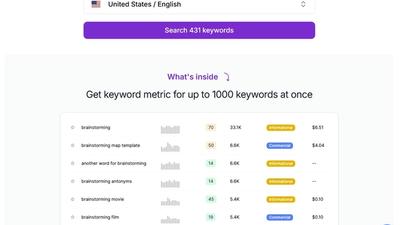
The tools that track these patterns are still emerging, but a solid keyword search tool can help you spot where AI conversations are happening in your space and where you're being left out.
How AI Changes Content Creation
Here's something that trips up a lot of marketers: content that ranks well in Google doesn't automatically get cited by AI.
Google rewards comprehensive content. Long articles. Lots of internal links. Keywords in all the right places. AI systems care less about length and more about clarity. They need to quickly figure out if your content actually answers a question. If your page spends 400 words on preamble before getting to the point, an AI might skip you and cite someone who leads with the answer.
This doesn't mean writing dumbed-down content. It means front-loading value. Put the answer first. Then expand on it. Structure things so an AI can pull out a clean, quotable statement.
How AI Changes Ranking and Visibility
In Google, visibility is a spectrum. You might rank #1, #5, or #47. There's always a position.
In AI search, it's binary. You're either in the answer or you're not. There's no "page two" of a ChatGPT response. The AI picks its sources and moves on.
The signals that get you cited are different too. AI systems look for content that shows up consistently across trusted sources, gets referenced by other authoritative sites, and provides direct answers to specific questions. Backlinks still help, but they're not the whole story.
How AI Search Engines Consume and Cite Content
Different AI platforms work differently. Perplexity searches the web in real time and cites sources as it goes. ChatGPT mixes training data with live search. Google's AI Overviews pull from indexed pages but synthesize answers in their own way.
What they all share is a preference for content that's well-organized, factually consistent, and aligned with what other credible sources say. If your website claims one thing and your LinkedIn profile says something else, AI systems get hesitant. They don't like contradictions.
AI SEO vs Traditional SEO
Let's be clear: this isn't either/or. Traditional SEO drives real traffic and real revenue. Google still handles the majority of searches. Abandoning traditional SEO would be foolish.
But pretending AI search doesn't exist would also be foolish.
Where Traditional SEO Still Works
If someone searches "buy hiking boots" or "dentist near me," Google's organic results are still the main game. High-intent transactional searches. Local queries. Product comparisons. These are traditional SEO territory, and that's not changing anytime soon.
Backlinks still matter for these queries. Site speed matters. Mobile optimization matters. If your business runs on local search or straightforward product sales, keep doing what you're doing.
Where Traditional SEO Falls Short
Traditional SEO wasn't built for conversations. When someone asks ChatGPT "What invoicing software should I use for my freelance business?" they're not getting a list of links. They're getting a recommendation. Maybe FreshBooks. Maybe Wave. Maybe something else entirely.
If your content isn't structured to be that recommendation, you're not in the running. You could have the best backlink profile in your industry and still be invisible in AI search because your content doesn't give AI systems what they need to cite you confidently.
What AI SEO Adds
Think of AI SEO as a layer on top of traditional SEO. It adds optimization for how AI systems find and cite content, structural changes that make your pages easier to extract quotes from, brand consistency work across platforms, and tracking for AI-specific metrics.
The companies getting the best results treat AI SEO as an evolution of their existing strategy, not a separate silo.
What's Included in AI SEO Services?
Quality varies a lot in this space. Here's what a solid AI SEO service should actually include:
AI-First Keyword and Topic Modeling
This means identifying the questions your audience asks AI tools, not just what they type into Google. It involves tracking where your brand appears (and doesn't appear) in AI responses, and finding gaps where competitors are getting cited and you're not.
Search Intent Mapping Across Platforms
Someone on Google might be browsing. Someone on ChatGPT usually wants a straight answer. Someone on Perplexity wants facts with sources. Good AI SEO maps these differences and creates content that works across all of them.
Content Designed for Multiple Outcomes
The best AI SEO content does three things: it ranks in traditional search, it earns AI citations, and it directly answers the questions buyers ask when they're ready to make a decision.
This takes deliberate structuring. Opening sections need extractable answers. Body content needs to expand with specifics. The whole piece needs to satisfy human readers who actually click through.
A premium content bundle built for AI SEO delivers this kind of content at scale.
Authority Signals Beyond Backlinks
AI systems evaluate trust differently than Google does. They look at how often your brand gets mentioned across the web, whether your information is consistent everywhere, and whether authoritative sources reference you.
Building these signals involves digital PR, content partnerships, and making sure your brand information is accurate across every platform where it appears.
Freshness and Update Mechanisms
AI tools with real-time search capabilities favour current information. A page you published three years ago might get passed over for something published last month, even if your content is still accurate.
Good AI SEO includes refresh strategies to keep important pages current and citation-worthy.
How AI Search Engines Choose Which Brands to Recommend
This is where things get interesting. AI systems don't just randomly pick sources. There are patterns.
Trust Evaluation
AI looks at whether your brand is mentioned consistently across credible sources. Does your website say the same thing as your Wikipedia entry, your LinkedIn, your Crunchbase profile? Are you referenced in contexts that suggest expertise? These signals combine into a trust profile that influences whether an AI feels confident recommending you.
Structured Content Preference
AI platforms love content that's easy to parse. Clear headings. Logical flow. Explicit statements of fact. If your content meanders or buries key information, AI has a harder time citing it.
This is why pages optimized for AI tend to have definition paragraphs near the top, comparison sections, and direct answers to common questions.
Brand Mention Patterns
Frequency matters, but so does context. Getting mentioned on authoritative industry sites carries more weight than random blog mentions. Consistent association with specific topics helps AI categorize when to recommend you.
Vendor-Owned Content Advantage
This one surprises people: AI systems often prefer citing content published directly by the brand being discussed. Your product pages, documentation, and blog posts can be cited directly if they're structured well.
This makes investing in your own content especially valuable. You're not just building for Google. You're building citation-ready assets that AI can reference.
Who Should Use AI SEO Services?
AI SEO isn't equally valuable for everyone. It matters most for businesses where showing up in AI recommendations directly translates to revenue.
SaaS Companies
Software buyers ask AI for recommendations constantly. "What's the best project management tool for remote teams?" "Which CRM has the best Gmail integration?" If your software isn't showing up in these conversations, you're losing qualified leads who might never encounter your traditional marketing.
Marketing and Creative Agencies
Agencies need leads. When someone asks ChatGPT for "the best SEO agency in [city]" or "top branding firms for startups," getting mentioned is a warm introduction. It's third-party validation before you've even had a conversation.
High-Margin Service Businesses
If one client is worth tens of thousands of dollars, a single AI citation can deliver massive ROI. Consultants, advisors, professional service firms... the math works out fast.
Founders Building Personal Brands
When someone asks "Who are the top voices in [your field]?" AI draws from published content, media mentions, and online presence. Founders who invest in AI SEO can become the default answer in their category.
Companies Dependent on Inbound Demand
If your business grows through people finding you (rather than you finding them), AI SEO is becoming non-negotiable. The channels where discovery happens are multiplying. Optimizing only for Google means shrinking visibility over time.
Why SEO Stuff Is Built for AI SEO
Most SEO tools were built for traditional search. They're great at tracking rankings, analyzing backlinks, and finding keyword opportunities based on Google's organic results.
They weren't designed for a world where ChatGPT processes billions of queries daily.
SEO Stuff was built with AI visibility as a core focus. The platform recognizes that the same content often needs to work in both Google and AI platforms, and it helps you find opportunities where optimizing for one benefits both.
The focus is on decision-stage queries, the moments when someone is actively choosing between options. Those are the queries where AI recommendations carry the most weight.
For teams ready to execute, the Gold Plan provides the tools and data to run an AI SEO strategy. For those who need content built to spec, the Premium Content Bundle delivers strategically structured content designed for both rankings and citations.
How to Choose the Right AI SEO Service Provider
This space is new. Quality varies wildly. Here's how to separate the real players from the pretenders.
What to Look For
Ask for proof of AI visibility results. Not just ranking improvements, actual examples of clients appearing in ChatGPT, Perplexity, or AI Overviews. A quality provider should understand how each platform works and have tactics tailored to each.
They should also explain how AI SEO connects to traditional SEO. If they treat it as a completely separate thing, they're probably missing the bigger picture.
What to Avoid
Run from anyone promising guaranteed AI placements. Nobody can guarantee what ChatGPT will say. The models change. Training data evolves. Real-time search results vary by context. Anyone promising guarantees is either lying or doesn't understand how this works.
Also watch out for providers who conflate "AI SEO" with "using AI to write content." Those are two completely different things. Pumping out ChatGPT-written articles isn't AI SEO. It's content automation. It won't improve your visibility in AI search and might actually hurt your credibility.
Red Flags
Be skeptical of vague methodology. AI SEO requires specific technical knowledge about how AI systems evaluate and cite content. "We'll optimize you for AI" without concrete tactics is a red flag.
Also be cautious of single-platform focus. ChatGPT matters, but so do Perplexity, Google AI Overviews, Claude, and whatever comes next. A real strategy covers the ecosystem, not just one tool.
AI Content Is Not AI SEO
This distinction is worth repeating. Using AI to write your content is a production method. Optimizing your brand to appear when people use AI to search is a visibility strategy. They're not the same thing.
True AI SEO services focus on getting cited by AI platforms, not just using AI platforms to create content.