What Is Data Validation in Excel? A Complete 2026 Guide
 Carlos Garcia5/14/2026
If you've ever opened a spreadsheet built by someone else and found dates in the wrong format, phone numbers with letters in them, or a "yes/no" column that somehow contains "maybe" and "idk," you've seen what spreadsheets look like without data validation. Data validation is Excel's built-in defense against bad input — a set of rules you can attach to any cell or range that controls exactly what users can type. This article shows you what data validation is, why it matters, the seven types of rules available, and the practical scenarios where it saves hours of cleanup work.
Free SEO + AI Search Audit. Spreadsheets keep your data clean. But what about your website's data — the structured markup, metadata, and content that determines how Google and AI search engines understand you? Most sites have errors costing them rankings. Run your free audit → to see exactly where your site stands in Google, ChatGPT, Claude, Perplexity, and Gemini.
What Is Data Validation in Excel?
In simple terms, data validation in Excel is a feature that restricts what users can enter into a cell. You define a rule — like "only whole numbers between 1 and 100" or "only dates after January 1, 2026" or "only values from this dropdown list" — and Excel enforces it. If someone tries to type something that breaks the rule, Excel either rejects the input outright or shows a warning, depending on how you configure it.
Think of data validation as a doorman for your spreadsheet. The doorman has a list of who's allowed in (the validation rule), checks every person who tries to enter (every value typed into a validated cell), and decides whether to let them through. The result is a spreadsheet where the data going in is consistent, clean, and predictable — which makes everything downstream (formulas, pivot tables, charts, exports) far more reliable.
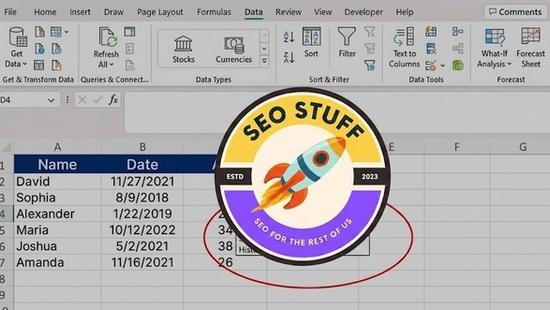
Data validation lives in the Data tab of the Excel ribbon, in a section called Data Tools. The dropdown gives you the full toolkit: setting up validation rules, finding cells that already have rules, and circling invalid data so you can clean it up.
Why Use Data Validation?
Data validation exists for one reason: garbage in, garbage out. Every spreadsheet that gets used by more than one person eventually accumulates inconsistent data — different date formats, varying capitalizations, typos, accidental letters in number columns. The bigger the spreadsheet and the more people touching it, the worse it gets. Data validation prevents the mess at the source instead of trying to clean it up after.
Saving Hours on Data Cleanup
If you've ever inherited a 5,000-row spreadsheet and had to figure out why some rows have "USA," some have "United States," some have "U.S.A.," and one has "Untied States" (typo), you understand the value of validation. A dropdown list with three approved values would have prevented every one of those variations. Multiply that across every column in every shared workbook in a company, and data validation easily saves analysts and ops teams hundreds of hours per year.
Making Formulas and Pivot Tables Actually Work
Excel formulas are deeply unforgiving. A SUMIFS that filters on "Region = West" will silently miss every row where someone typed "west " (with a trailing space) or "West " or "Western." Pivot tables will create separate categories for "Pending," "pending," and "PENDING," making it look like you have three statuses when you really have one. Data validation forces consistency at input time, which means your downstream analytics actually report what you think they're reporting.
Free SEO + AI Search Audit. The same "garbage in, garbage out" rule applies to SEO. If your site's metadata, schema markup, or content structure has inconsistencies, AI search engines like ChatGPT and Perplexity can't make sense of you — and neither can Google. Run a free audit to see where your site has the equivalent of "Untied States" in its SEO data, and how to fix it.
Types of Data Validation Rules in Excel
Excel offers seven core validation rule types, each suited to a different kind of input. Here's what each one does and when to use it.
List (Dropdown)
The most-used validation type. You specify a list of allowed values, and Excel turns the cell into a dropdown. Users can only pick from your list — no typing arbitrary values.
- Static list: Type values directly into the validation dialog, separated by commas (`Yes, No, Maybe`).
- Range-based list: Point validation at a range of cells (`=$F$1:$F$5`). Editing that range updates every dropdown that references it.
- Named range: Use a named range (`=Departments`) for cleaner formulas and easier maintenance.
Best for: status fields, categories, regions, departments, anywhere a fixed set of values applies.
Whole Number and Decimal
Restricts input to numbers within a specified range. You can require equal to, not equal to, greater than, less than, between, or not between specific numeric bounds.
Best for: prices, ages, quantities, ratings, percentages — any numeric field with known min/max bounds.
Date and Time
Same logic as Whole Number, but for dates and times. You can constrain to dates after, before, between, or equal to specific dates — including dynamic dates calculated from formulas like `=TODAY()`.
Best for: project deadlines, event dates, birthdays (often combined with TODAY-based age limits), time entries.
Text Length
Validates the number of characters in the input — useful when you have fixed-format codes like SKUs, employee IDs, or phone numbers.
Best for: ID fields, codes, fixed-length identifiers.
Custom (Formula-Based)
The most powerful validation type. You write a formula that returns TRUE or FALSE, and Excel allows the input only when TRUE. This lets you build virtually any rule — including cross-cell validation, regex-style pattern matching with formula combinations, and conditional logic.
Examples:
- `=ISNUMBER(A1)` — only allow numeric input
- `=A1>B1` — only allow if A1 is greater than B1
- `=COUNTIF($A$1:$A$100, A1)=1` — only allow unique values
- `=LEFT(A1,3)="EMP"` — only allow values starting with "EMP"
Best for: complex business rules, uniqueness checks, conditional validation across multiple cells.
Free SEO + AI Search Audit. Most SEO problems are exactly like data validation problems — they're invisible until your traffic drops or you stop appearing in AI search results. Get a free audit of how your site performs in Google AND in ChatGPT, Claude, Perplexity, and Gemini — the four AI platforms now driving real referral traffic for early movers.
How to Set Up Data Validation in Excel (Step-by-Step)
Setting up data validation is straightforward once you've done it a few times. Here's the basic flow:
- Select the cell or range where you want to enforce the rule. Validation applies only to selected cells — you can't validate an entire column unless you select the entire column first.
- Go to the Data tab in the Excel ribbon, then click Data Validation in the Data Tools group.
- In the Settings tab, choose your rule type from the Allow dropdown (List, Whole number, Decimal, Date, Time, Text length, or Custom).
- Configure the rule. For a List, type your values separated by commas or point to a range. For numeric/date rules, set the comparison operator (between, greater than, etc.) and the bounds.
- (Optional but recommended) Set an Input Message. In the Input Message tab, write a short message that appears when the user clicks the cell — something like "Enter a value between 1 and 100." This helps users follow the rule before they hit it.
- (Optional) Set an Error Alert. In the Error Alert tab, choose Stop (hard reject), Warning (let user override), or Information (just show a notice). Write a clear error message so users know what to do.
- Click OK to apply.
To find every cell in a worksheet that already has validation, press F5 (Go To), click Special, and choose Data validation → All. Excel highlights every validated cell. The same dialog lets you find every cell that violates its rule using Data → Data Validation → Circle Invalid Data.
When Should You Use Data Validation?
Data validation is overkill for one-person personal spreadsheets. It pays off when more than one person touches the data, or when bad input has expensive downstream consequences. Here are the most practical scenarios:
1. Shared Forms and Input Sheets
Anytime you build a sheet that other people will fill in — expense reports, project intake forms, survey responses, sales pipelines — validation is non-negotiable. Without it, you'll spend more time cleaning data than analyzing it. With it, you can pivot, filter, and chart from the moment the first row is entered.
2. Critical Calculations Tied to Categories
If your bonus calculations depend on a "Performance Tier" column with values "A," "B," or "C" — and someone types "a" (lowercase) — your IF formulas will silently break. Validation locks the allowed values, which means formulas can rely on exact-match comparisons without defensive lower-case wrangling.
3. Date-Driven Workflows
Project plans, deadline trackers, and time-sensitive workflows all break catastrophically when someone enters "next Tuesday" as text instead of a real date. Date validation forces actual date values, which means everything downstream (Gantt charts, deadline alerts, days-remaining formulas) works correctly.
4. Codes, IDs, and Fixed-Length Identifiers
Employee IDs, SKUs, account numbers, license plates — anything with a known format. Text Length validation catches mistakes immediately (someone enters 7 characters when the SKU should be 8), and Custom validation with LEFT/MID/RIGHT functions can enforce the actual character pattern.
5. Preventing Duplicates
For columns where every value must be unique (employee email, customer ID, license number), use Custom validation with `=COUNTIF(column_range, current_cell)=1`. The rule rejects duplicates as they're typed instead of letting you discover them weeks later in a deduplication script.
Free SEO + AI Search Audit. Data validation prevents duplicate, inconsistent, or malformed data in your spreadsheets. The same kind of inconsistencies on your website — duplicate title tags, conflicting meta descriptions, broken schema markup — silently kill your search rankings. Run a free audit to see exactly where your site's SEO data has gaps, and the highest-impact fixes for Google and AI search alike.
Limitations of Data Validation
Data validation is powerful, but it's not bulletproof. Knowing where it falls short prevents you from over-relying on it.
It doesn't apply to pasted data. This is the biggest gotcha. If a user copies data from elsewhere and pastes into a validated cell, Excel pastes it — even if it violates the rule. Excel will quietly disable validation on the pasted cells in some cases. To check, run Circle Invalid Data after big paste operations.
It doesn't run on existing data. Adding a validation rule to a cell that already has a value doesn't validate that existing value. The rule only triggers when someone tries to change the cell. Use Circle Invalid Data to find existing rule violations.
Error Alert can be bypassed (sometimes). The "Warning" and "Information" alert styles let users override the rule. Only "Stop" hard-rejects input — but even "Stop" doesn't prevent paste or programmatic input (e.g., formulas writing into the cell).
Custom formulas can be fragile. Formula-based validation breaks if the referenced cells change or get deleted. Document your custom rules so future editors don't accidentally undo them.
Validation is per-cell, not per-column. If you add 10 new rows below your validated range, the new rows don't inherit the validation unless your range was set up as an Excel Table (or you formatted the entire column). For tables that grow, structure your sheet as a Table (Insert → Table) so validation auto-extends.
Mobile and web Excel have feature gaps. Some validation rules created in desktop Excel display correctly but don't enforce in Excel for the web or mobile apps. Test critical workbooks across the surfaces your team uses.
Final Thoughts
Data validation is one of those Excel features that pays for itself the first time it catches a bad input. For solo spreadsheets, it's a nice-to-have. For shared workbooks, financial models, and operational trackers, it's the difference between data you can trust and data you'll spend hours cleaning.
If you take one habit from this article, make it this: any time you build a shared spreadsheet, spend five extra minutes adding validation to every input field before you send the link. The first time someone types "yes" instead of "Yes" and breaks your status filter, you'll be glad you did.
And if data integrity matters for your spreadsheets, the same principle applies to your website. Search engines — both Google and AI platforms like ChatGPT, Claude, and Perplexity — penalize sites with messy or inconsistent metadata, broken structured data, and duplicate content. Most site owners have no idea where their SEO data is failing because the new AI search engines evaluate sites very differently than Google did five years ago. Run a free audit to see exactly how your site performs in Google AND every major AI search platform — and which fixes will move the needle fastest.